Unleash Wellbeing of RMG Workers through Inclusive Business Initiative
Seminar on “Unleash Wellbeing of RMG Workers through Inclusive Business Initiative”
Jointly organized by Dutch-Bangla Chamber of Commerce & Industry (DBCCI) & SNV Netherlands Development Organization on 17 July 2021 at Le Meridien, Dhaka
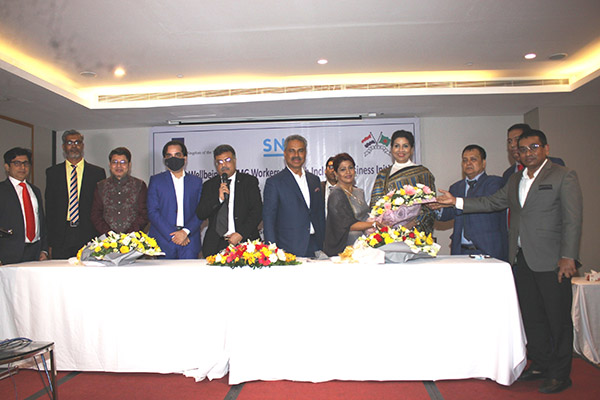
Dutch-Bangla Chamber of Commerce & Industry (DBCCI) and SNV Netherlands Development Organisation in Bangladesh jointly organized a seminar on Seminar on “Unleash Wellbeing of RMG Workers through Inclusive Business Initiative” on 17 July 2021 at Le Meridien, Dhaka.
Mr. Md. Anwar Shawkat Afser, President of Dutch-Bangla Chamber of Commerce & Industry (DBCCI) facilitated the seminar on Inclusive Business initiative. 4 piloting projects for the well-being of the RMG worker have been awarded which were funded by the government of the Netherlands. The winning entrepreneurs for serving RMG workers were TRIMOYEE for Eye treatment, Konna for women medical awareness, CMed for online medical service and Protein Nest for whole protein food in affordable packages.
He said Inclusive businesses bring people living at the base of the economic pyramid, those who are poor or underserved into value chains as suppliers, distributors, retailers, or customers. The dual focus of Inclusive Business, achieving both commercial viability and development impact, fosters opportunity and expands access using private-sector solutions that are sustainable, replicable, and scalable.
Mr. Anwar Shawkat Afser said, Bangladesh is a huge market for producing, buying, supplying, distributing and consuming innovative products and services by the low-income segments. A range of sectors, such as manufacturing, agribusiness, information technology, financial services, energy and retail has enormous opportunities for innovation of high-growth models that are not capital-intensive and more service-oriented. Inclusive business can be recognized as a financially viable firm. It can extend its arena from social enterprise status into serving broader markets and achieving higher returns, or highly profitable companies that want to deepen their reach towards more valuable social contributions.
Mr. Afser mentioned that DBCCI and SNV were working since 2017 for an inclusive business enabled environment and organized numbers of events to build interest in inclusive business and health and wellbeing of RMG workers. This Seminar on Unleash Wellbeing of RMG Workers through Inclusive Business Initiative is to facilitate a knowledge-based discussion and collaboration among the business entities, investors, innovators on Inclusive Business.
Mr. Faruque Hassan, President of The Bangladesh Garment Manufacturers and Exporters Association (BGMEA), graced the event as a Chief Guest. He welcomed the social entrepreneur who won the award fund for piloting for the RMG worker, specially, for the women workers. He said the workers are the main part of our success. We are the second largest RMG exporter in the world due to their contributions. So these piloting projects are very important for the wellbeing of the RMG workers.
Mr. Faruque Hassan mentioned that Bangladesh is celebrating its 50 years of independence, and during these decades we have been established as a global surprise of economic prosperity from a so-called ‘basket case’. We have been able to consistently maintain a GDP growth over 7% in the last few years, the per capita income has just grown above 2227 dollars, export and import has crossed 100 billion dollars, life expectancy has increased, and we were quite outstanding in achieving the MDG goals.
Thanks to our Honorable Prime Minister Sheikh Hasina for Her prudent leadership and her Vision to build an economically inclusive and prosperous society. We now believe that in the next decade, Bangladesh will be able to grow at around 8 percent or perhaps even faster. The RMG industry played a vital role behind all these achievements.
In fact the RMG industry has created 4.4 million direct jobs, the total employment including backward and forward linkage industries is around 10 million people and indirectly around 50 million people are depending on it for livelihoods. Therefore, the sustenance of our economic growth depends on the continued progress of this industry to a significant extent.
The journey of the RMG industry has never been so easy as it faced many cross roads, but has proved its resilience and capability. The industry has become stronger by learning from the mistakes, it is a time tested industry, which has made commendable progress in the area of sustainability, especially workers well being and industrial relations.
Starting from the elimination of Child Labor in mid nineties, and the emerging compliances issues including timely payment of wages, ensuring the minimum wage, overtime, hygiene at workplace, and so on, the industry has responded well on all the issues of compliance and workers rights. The industry is under close surveillance of multiple authorities as far as social compliance is concerned. And since the tragic building collapse accident in 2013, a paradigm shift has taken place in the area of structural, fire and electrical safety at the workplace which was supported by the international brands and donors like ILO, in addition to the lead role played by our government. Additionally, to ensure workers well-being and safety at the workplace, the Labor Act was amended twice in 2013 and in 2018, and Labor Rules was promulgated in 2015. Formation of safety committees in every factory has been made mandatory, workers participation committees have also been made mandatory through elections. A central fund has been created under the supervision of the government where garment factories are contributing $10 million of their export receipts to be used for the workers’ welfare purposes.
Even during this tough time of COVID pandemic we have been working hard to protect our workers from infection so that the balance between lives and livelihood of the millions can be maintained. When our factories were closed for up to 75 days, and we faced cancellation, deferred payments, and discounts, we continued to ensure wage payment and other well being of the workers. With Government’s support, RMG factories were re-opened in late April 2020, following strict health and safety protocols developed by BGMEA, Ministry of Health, ILO, and WHO. BGMEA played a crucial role in ensuring the compliance to the health protocol at factory level, took a staggered approach to re-open factories, and engaged with ILO to train master trainers to provide training on COVID awareness among workers and employees. The overwhelming response and cooperation from the factories should also be appreciated.
BGMEA established a PCR Lab for the workers, established 10-bed isolation center for women garment workers in Tongi with the support of Public Health Center Hospital and CARE Bangladesh, and another one of 50-bed has been set up at BGMEA Hospital in Chittagong, and opened a telemedicine facility for the workers. BGMEA also partnered with Inspectorio to help member factories mitigate Covid resurgence. BGMEA and Maya have signed an agreement to provide free services to help prevent and limit the spread of Covid-19, while also addressing general medical and mental health related issues amongst ready-made garment (RMG) workers. By the grace of Almighty, as a result of these timely taken initiatives, we have been able to contain the rate of infection in our industry within 0.03%.
As we have fast transformed our manufacturing as a responsible undertaking, the industry has earned prestigious recognition globally of the high standard as recently Bangladesh ranked 2nd in Ethical Manufacturing by QIMA.
The industry has also made strides in green industrialization. Bangladesh has the highest number of green garment factories in the world. Currently, we have 144 LEED green garment factories certified by the U.S. Green Building Council (USGBC) where 40 factories are Platinum. 39 out of the world's top 100 LEED green garment factories are in Bangladesh.500 more RMG factories have registered for the LEED certification.
It is a tremendous pride for us to share with you that BGMEA has been honored with the “2021 USGBC Leadership Award” for its exemplary leadership in promoting environmental sustainability and green industrialization in the RMG industry. BGMEA is the only association in the world to receive such an award and to be recognized as the pioneer in global green industries. With an ambition to reduce GHG emission by 30% till 2030, BGMEA has joined the UN Fashion Industry Charter for Climate Action.
As far as the empowerment of women is concerned, Bangladesh RMG industry has brought a silent revolution in the society. Over the last 40 years, this sector has benefited millions of women, who, if not, would be considered a burden to the family. The accomplishments of the RMG industry has been reflected in a study report “A Survey Report on the Garment Workers of Bangladesh” conducted by Asian Centre for Development published in 2020, shows that this is the first job of the majority of female workers of this sector; this truly indicates the sector as a key source of women empowerment. However, we admit that although almost 60% of our workers are female, they are lagging behind in terms of participation in the higher grades. We are working to minimize the gap and ensuring female participation in the higher and mid-level (as CAD operator, supervisor, and Virtual Prototyping machine operator) is one of the most important agenda of ours. Along with that, a total of 60 female garment workers have been given a chance to pursue their higher education at Asian University of Women (AUW) with the assistance from the respective factory owners by carrying out their educational expenses.
I must mention that the bilateral relation between Bangladesh and The Netherlands is deeply rooted since the independence of Bangladesh in terms of trade, aid and people to people relations. The Netherlands is the 8th largest foreign investor and 9th largest bilateral trade partner for Bangladesh. The Netherlands is an important market for our readymade garment products which was 814 million dollar in the last fiscal year. The Netherlands' role to support our garment industry to improve workplace safety, labour rights and general business conduct is tremendous. I would like to express our gratitude to the Government of Netherlands for all the support you are providing, like - the Working Condition Improvement program with ILO, capacity building program through CBI, and Partnership for Cleaner Textile project.
Mr. Faruque Hassan also addressed the journalists to tell the positive and successful story of Bangladesh repeatedly not to focus on the negative things. We had a glorious past and we have the ability to establish a glorious future of Bangladesh.
We wish to enhance and extend the scope of collaboration between our two countries to work on areas where we can cut time and cost, make sourcing more sustainable and would also help foresee our growth prospects. Capacity building assistance like training of the workers and mid-management on technologies and leadership skills, joint scoping missions to explore foreign investment opportunities in backward linkage textile, especially non-cotton textile industries are some of the promising areas of collaboration.
With these few words let me conclude my remarks, and let us continue the dialogue to take joint initiative to promote business and investments between Bangladesh and the Netherlands, with an aim to ensure better living of our people, and most importantly how we can project the positive side of our nation and the industry globally.
Mr. Faiyaz Murshid Kazi, Director General, Ministry of Foreign Affairs represented the Ministry of Foreign Affairs as a Guest of Honour. He appreciated the start-up young social entrepreneurs who shared their challenges, possibilities and won the piloting project for the well-being of RMG workers. They are charting pathways for us not only for RMG sectors but also for all the manufacturing industries of Bangladesh. He praised the initiative of DBCCI and SNV. Specially, the mental health issue, this is important not only for RMG workers but also needed for all of the public sectors. Mr. Faiyaz focuses on disseminating the positive narratives of our stories to abroad. He recognized the relationship with the Kingdom of the Netherlands. It is historically a very engaging, rich, diversified relationship. The Netherlands is also a riverine delta like us. We have had very extensive cooperation in the water management sector over many years. We also see their engagement in agriculture, manufacturing, information technology, and other new areas.
Mr. Faiyaz referred to the Father of the Nation, Bangabandhu Sheikh Mujibur Rahman, as he used to talk about farmers, labour and hardworking people, we have to take care of to keep their interest in such a manner. The main objective of Sonar Bangla was to put a smile on the face of the people at the base of the social pyramid. Rokeya Shakhawat Hossain is said to have brought out the besieged women to the light 100 years ago. We want to come out from the besieged age. We want to see our women's society reflect their merit, talent, skills and qualifications in all sectors not only in the country but also around the globe. Mr. Faiyaz assured all support to DBCCI from the ministry of foreign affairs.
Mr. Jamal Uddin, Inclusive Business Advisor, RMG Inclusive Business Program from SNV Netherlands collaborated on the piloting project for the wellbeing of RMG workers. He mentioned the objectives of the seminar focus on potential and emerging inclusive business options to improve the health, food, nutrition, energy, water & sanitation of low-income groups for social impact. To share the success stories & lessons learnt of the inclusive business model in the RMG sector. And reveal the potential opportunity for collaboration & partnership.
Mr. Md. Shahjahan Shaju, Vice President, Mr. Md. Nazmul Haque, Director was present from DBCCI. Mr. Md. Shakawat Hossain Mamun, Secretary General, DBCCI, Mr. Tawhida Shiropa, Founder & CEO, Moner Bondhu Mr. Mamunur Rahman, Founder, Ella Pad participated as panelist. DBCCI Members, Business leaders and many start-ups were present in the event. The program ended followed by dinner.